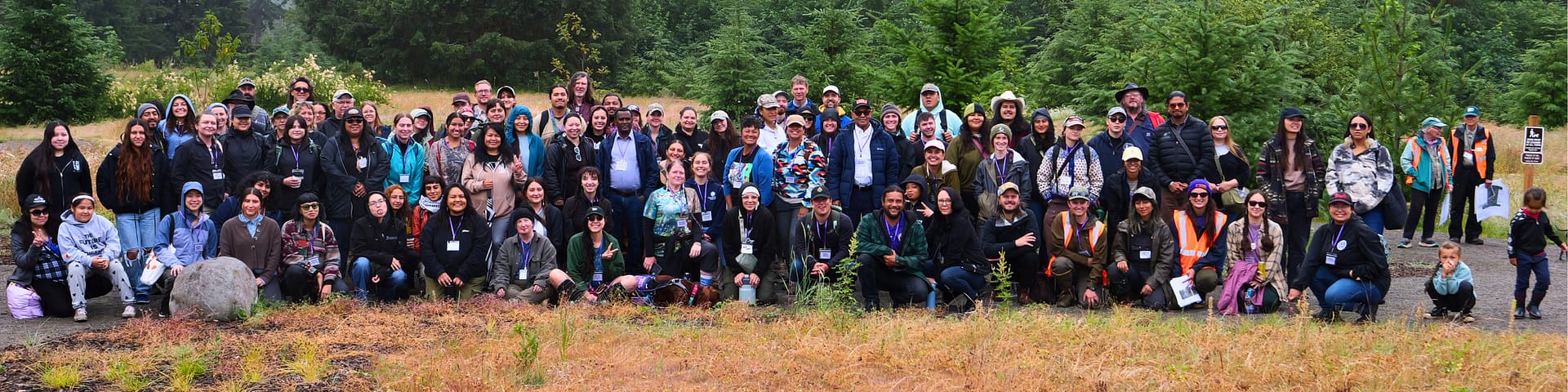
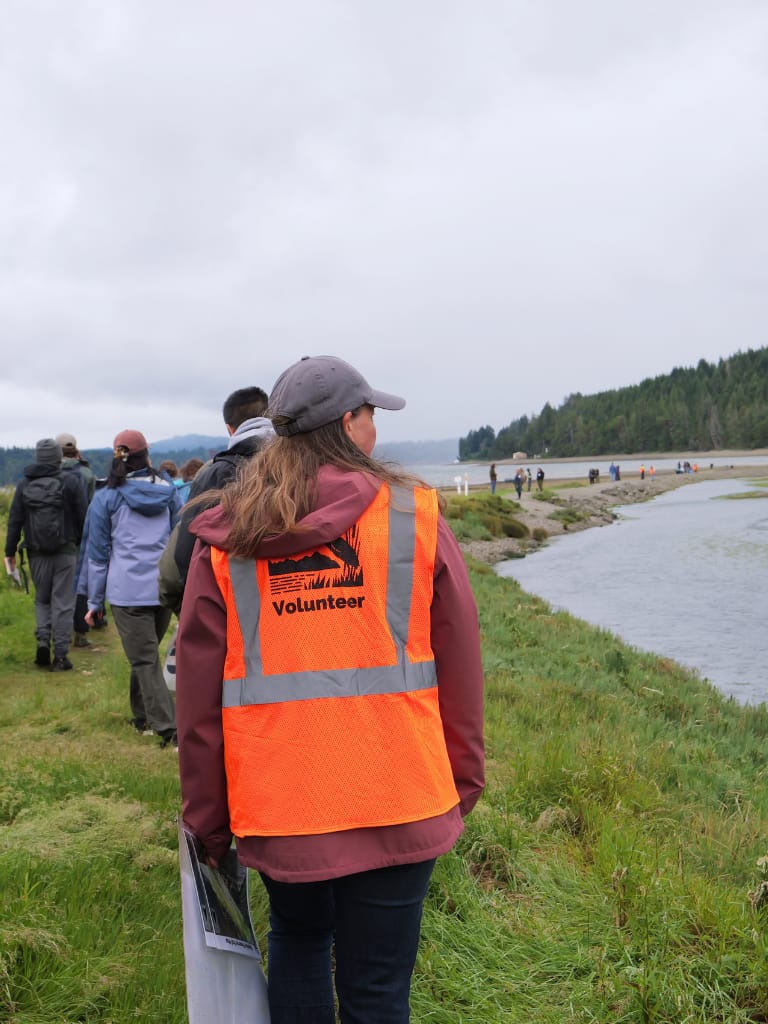
 On June 26, 2026 more than 100 participants from this year’s Indigenous Agroforestry Network Gathering visited Bayshore Preserve.
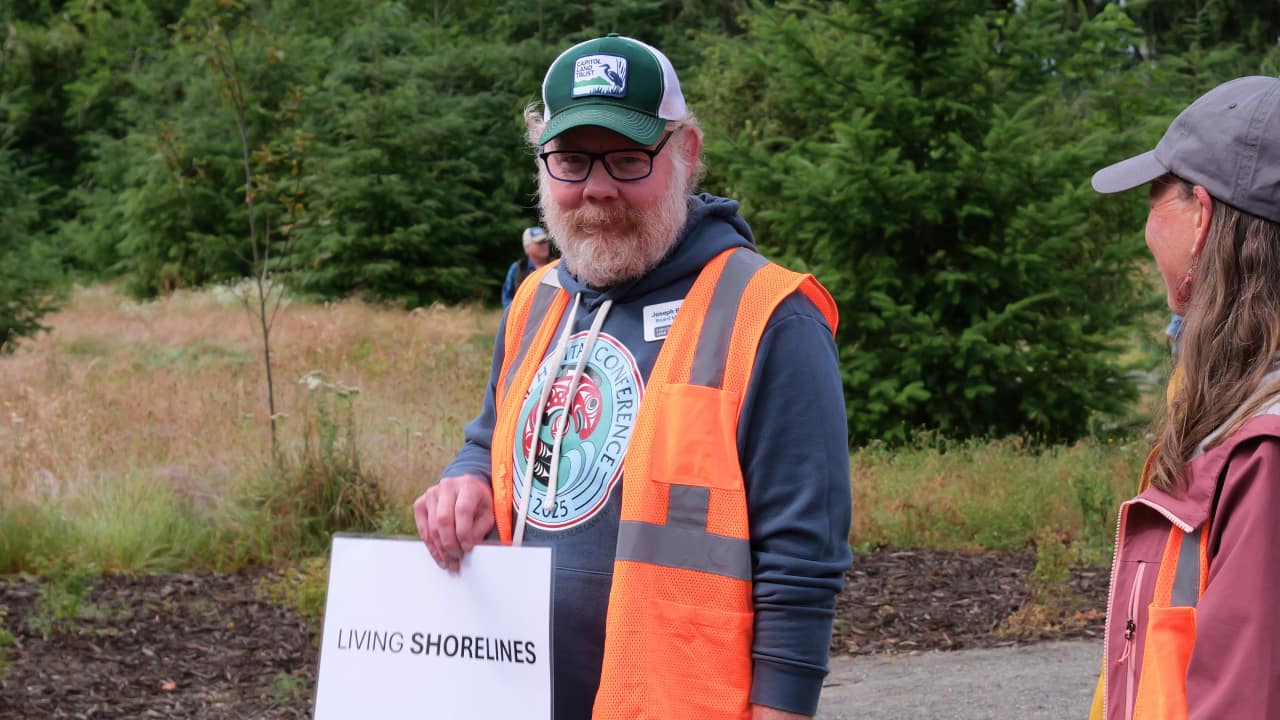
“Where you’re standing, there is a layered history connected to the land and water,” a voice begins, piercing through the anticipatory quiet of the growing crowd. The voice belongs to Joseph Peters, both a Squaxin Island Tribe and Capitol Land Trust (CLT) Board member, who is welcoming Ecotrust’s Indigenous Agroforestry Network (IAN) Gathering to Bayshore Preserve, located just north of Shelton.
The IAN Gathering is an annual opportunity for land stewards and agroforestry practitioners from across the country to come together to share teachings and best practices. On this overcast morning in late June, more than a hundred participants are celebrating the culmination of this three-day event with a visit to the Bayshore Peninsula, a spit of land jutting out into Oakland Bay with a history as rich as its biodiversity.
Bayshore Preserve Both Past and Present
“Before this became a preserve, it was inhabited by the Squaxin Island Tribe, the people of the Hammersley Inlet Clan, sʔəhiw̓ (Sa-Heh-Wa-Mish),” Peters explains. “There would have been one of the largest longhouses out here at the mouth of Johns Creek. We lived off the shore and we ate the fish and the clams. We really relied on this land.”
-

- Joseph Peters is a member of both the Squaxin Island Tribe and CLT’s Board of Directors.
That way of life carried on generation after generation, until the Medicine Creek Treaty of 1854 was signed. Soon after, a sawmill was built along the creek and in 1930, the nearly 80-acre peninsula was transformed into a golf course.
“It’s hard to imagine that this was once a golf course,” Peters says, eyes scanning the horizon. “That is until about 2014, when Capitol Land Trust came in and put it in conservation.” In the years since, CLT has worked diligently to restore the property, removing artificial marine barriers to enhance salt marsh habitat and replanting prairies with many of the same native species that were found here when this was Squaxin land.
“Today, I want you to come out here and enjoy this place and reflect and think about what it may have looked like out here back before 1854,” invites Peters, “and how our people, the Squaxin, lived out here and our connections with this land.”
A Lasting Connection
That connection continues to this day through an ongoing partnership between CLT and the Squaxin people, who still come to Bayshore to harvest camas, fish for salmon, and dig for shellfish on protected tidal mudflats. “Squaxin Island Tribe still has a presence here,” Peters shares. “We still fish, we still clam dig out here every season.”
“People continue to connect with this land,” he adds. And for those visiting today as part of the IAN Gathering, this connection appears in ways both big and small.
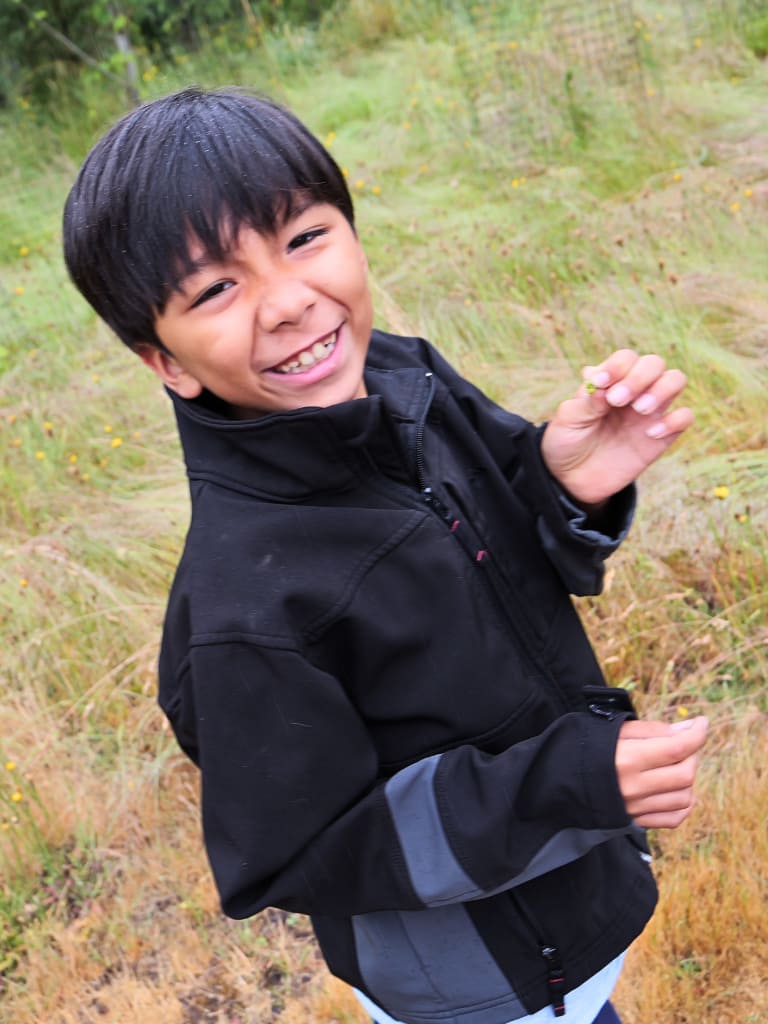
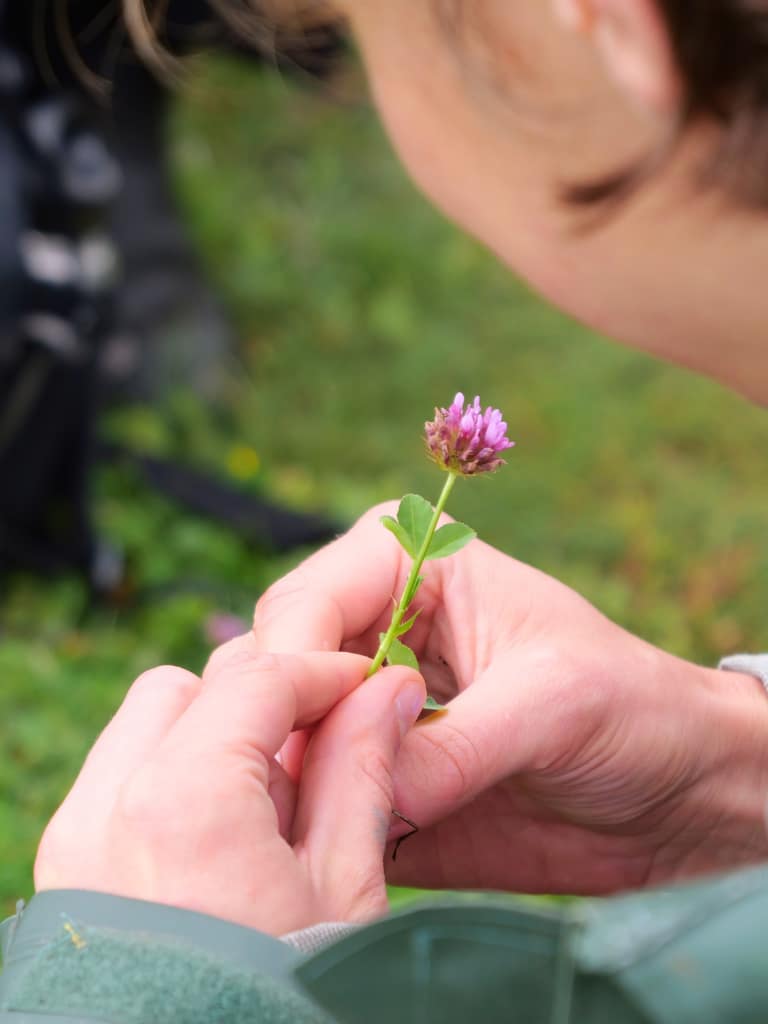
It is found in the joyful discovery of springbank clover dotting the shoreline, a rare find according to two students from Evergreen State College who enthusiastically collect samples to view later under a microscope. It is evident in Squaxin Tribal member Redwolf Krise’s desire to “re-learn the old ways” as he crouches down to pick a plantain leaf, sharing that this can be used as a bandage that naturally prevents bleeding. It lives in the moment of reciprocity when, beside the plantain, another IAN participant identifies chamomile and shares the many medicinal uses of its flower.
More Than Just Conservation
Peters concludes his remarks by observing, “This isn’t just about conservation. It’s about continued future connection to this land, forever. I know my people, the Squaxin people, will always be here.”
Now that the land is protected in perpetuity, it, in turn, will always be here for the Squaxin people and for visitors like those at the IAN Gathering who can find connection in this special place called Bayshore Preserve.